
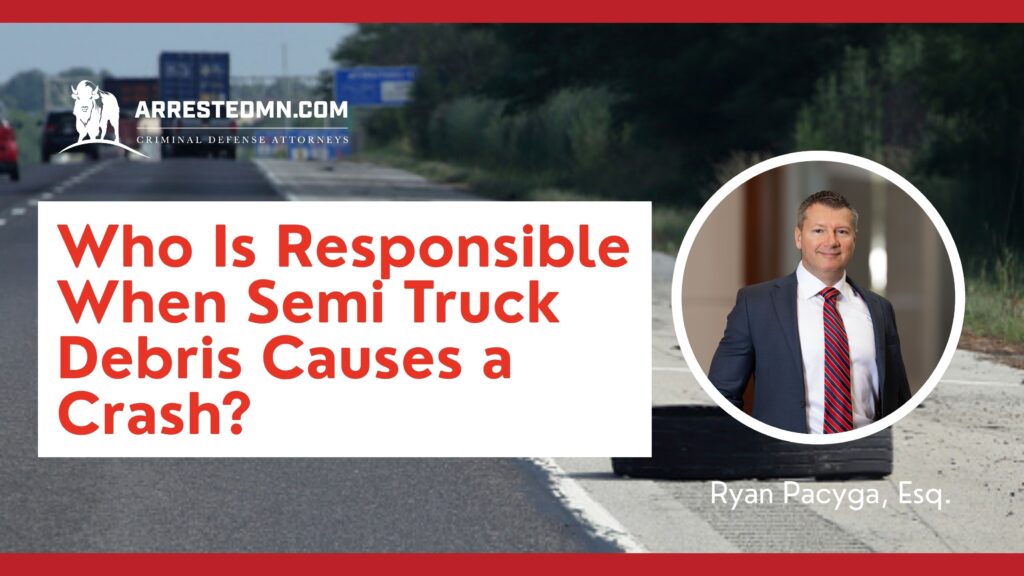
Driving at highway speed and suddenly seeing a huge strip of semi truck tire flying toward the windshield is every driver’s nightmare.
There is almost no time to react. A split second can mean the difference between a scare and a life‑changing crash.
Most people see shredded truck tires on the shoulder and think, “Someone had a blowout.” In many cases, that is where the thought process stops.
In a serious injury or wrongful death case, that is where the investigation should start.
Semi truck tire failures can be the result of neglect, poor maintenance, defective tires, or a combination of problems. When debris from a truck tire causes harm, the key questions are:
- Why did the tire fail?
- Who knew or should have known about the danger?
- Who put that unsafe truck on the road?
This article explains how these cases work from the perspective of Pacyga Trial Lawyers, and what injured people and their families in Minnesota should know.
Why semi truck tire failures are so dangerous
A fully loaded tractor‑trailer can legally weigh up to 80,000 pounds under federal law. All of that weight rides on a set of tires moving at 60 to 70 miles per hour, sometimes faster.
When a truck tire fails at speed, the result is not a simple flat:
- Large chunks of rubber and steel‑belted material can peel away from the tire
- Debris can land directly in travel lanes
- Drivers of passenger vehicles may have almost no time to respond
Common scenarios include:
- A car hits the debris and loses control
- A driver swerves suddenly to avoid the tire and goes into another lane
- A vehicle strikes another car while trying to avoid the debris
- A large piece of tire flies through a windshield or strikes the roof or hood
In seconds, what started as a tire problem becomes a serious personal injury or wrongful death crash.
Who may be responsible when a truck tire fails?
Responsibility for a semi truck tire failure is not always simple. Several different parties may share fault, depending on what went wrong.
1. The truck driver
Commercial truck drivers are required to operate safe vehicles and to perform regular inspections.
Federal Motor Carrier Safety Administration (FMCSA) regulations require drivers to conduct pre‑trip inspections of their trucks and trailers. Drivers are expected to identify and address obvious tire problems such as:
- Severely worn tread
- Bulges, cuts, or visible damage
- Sidewall separation or cracking
- Leaks or low tire pressure
- Exposed ply or belt material
If a driver knows, or should have known, that a tire is damaged or unsafe and chooses to keep driving anyway, that decision can become important evidence in a crash investigation.
2. The trucking company (motor carrier)
Trucking companies have their own separate responsibilities under federal law. Motor carriers must:
- Inspect, repair, and maintain their vehicles and tires
- Keep maintenance and inspection records
- Comply with detailed equipment safety standards
FMCSA regulations identify specific tire conditions that make a truck out of service, including:
- Exposed ply or belt material
- Tread or sidewall separation
- Tread depth below minimum standards
- Improper repairs such as unsafe plugs or patches
A company that cuts corners on maintenance, skips inspections, or ignores a history of tire problems may bear significant responsibility when a tire fails.
Patterns matter. Evidence of:
- Repeated tire failures
- Poor inspection policies
- Pressure on drivers to keep moving despite defects
can all be critical in proving negligence.
3. Tire service or maintenance companies
Many trucking companies outsource tire work to third‑party service or maintenance providers. These companies may be hired to:
- Inspect tires
- Mount and balance new or retreaded tires
- Repair punctures or damage
- Rotate and replace tires
If a service provider performs work incorrectly or fails to detect an obvious safety issue, that failure can become another focus of the investigation. Examples include:
- Mounting the wrong size tire
- Failing to properly seat or secure the tire on the rim
- Neglecting to replace a tire that clearly did not meet safety standards
In some cases, both the trucking company and the maintenance provider may share responsibility.
4. The tire manufacturer
Not every truck tire failure is caused by poor maintenance. Sometimes the tire itself is defective.
Tires can fail due to:
- Manufacturing defects that affect the way the tire was built
- Design defects that make the tire inherently unsafe under normal conditions
- Quality control problems that let bad tires leave the factory
When a defective tire fails and causes a crash, the manufacturer can face liability under product liability law. These cases often require experts to examine the tire and determine:
- Whether the failure pattern suggests misuse, lack of air, overloading, or a manufacturing flaw
- Whether similar tires have failed in the same way
- Whether the design complied with industry and federal safety standards
This is why it is so important not to look at a blown truck tire and assume the cause. The tire needs to be preserved and evaluated by qualified professionals.
What to do after a crash involving semi truck tire debris
Evidence in these cases can disappear quickly.
- The truck may continue down the highway.
- The failed tire or wheel may be removed and replaced.
- The debris may be cleared from the road.
- Maintenance records may change as new work is done.
Some of the most important evidence includes:
- The tire itself and all associated parts
- Electronic control module or “black box” data from the truck
- Electronic logging device (ELD) data
- Maintenance and inspection records
- Driver logs and pre‑trip inspection forms
- Photographs and video of the scene, debris, and vehicles
- Surveillance or traffic camera footage
- Dash cam video from the truck or other vehicles
If it can be done safely, basic steps at or shortly after the scene can help:
- Photograph the debris from multiple angles
- Photograph the roadway, skid marks, and surrounding area
- Photograph the damage to the vehicle, inside and out
- Note the truck’s company name, USDOT number, license plate, and trailer number
- Get contact information for witnesses, if possible
In serious injury or wrongful death cases, it is rarely realistic for an injured person or grieving family to manage all of this alone. That is where a focused trucking injury law firm becomes important.
Pacyga Trial Lawyers investigates:
- The crash itself
- The truck
- The driver
- The trucking company
- The maintenance and tire service records
- The electronic and documentary evidence that can explain why the tire failed
The goal is to move quickly enough that evidence is preserved before it is lost.
Why these cases are often complicated and nonsensitive
Trucking companies and their insurance carriers often have rapid‑response teams that can include:
- Adjusters
- Investigators
- Defense lawyers
- Accident reconstruction experts
These teams may become involved within hours of a serious crash.
That speed gives them a head start in shaping the narrative and controlling key evidence.
For injured people and their families, this means:
- Time matters
- Early legal advice can make a real difference
- Waiting and hoping the truth “comes out on its own” is rarely enough
Before giving a recorded statement, signing documents, or accepting any offer connected to a crash involving semi truck tire debris, it is wise to talk with a lawyer who understands trucking law and tire failure cases.
The question that drives the investigation
The next time a large strip of semi truck tire is spotted on the shoulder, it is natural to think, “Someone had a flat.”
From a legal and safety perspective, the more urgent question is:
What could happen if that tire comes apart at highway speed?
For the person who ends up being hit by that debris, the follow‑up questions become:
- Why did this tire fail?
- Who allowed this truck to be on the road in this condition?
- What safety rules were ignored or broken?
At Pacyga Trial Lawyers, serious Minnesota trucking cases involving tire failures are treated as preventable tragedies that demand answers, not unsolved mysteries to be written off as “just an accident.”
The firm’s role is to dig into the evidence, hold the right people accountable, and help clients and families rebuild their lives after devastating crashes that should never have happened.